Showing posts sorted by relevance for query willcocks. Sort by date Show all posts

Wednesday, March 25, 2009

M. P. Willcocks was a Writer from the West


Some time ago I posted extracts from a cluster of poems of mine inspired by one of the novels and the life of the Devonian writer Mary P. Willcocks who was born in 1869 140 years ago. Some ten years older than Mary Webb by 1908 - by which time she had completed two novels - Willcocks had established a status as an esteemed national writer of fiction. The writer was born and spent most of her life in Devon and there is some justification for a consideration of her writing as being as significant to Devon as was Webb's to Shropshire; it is in any case quite possible that Webb was influenced by Willcocks' work whilst she was completing the first of her novels (The Golden Arrow). Willcocks' novels - though they are not restricted to the county - do on the whole focus around the Devonian scapes of moor and sea and her stories are awash with local (late C19/early C20 ) and mostly rural characters. As a Devonian I would love to have had the opportunity to read her novels some years ago. During times when I have turned to Mary Webb, looking for someone who was able to bind external landscapes to internal manifestations of personality and plot - and finding in her just that ability to capture the timeless essence of a particular scene and mould it so as to transform her characters into seemingly real people one could have met at the time and inevitably drawing one to make visits to the Shropshire places which inspired her - it would have been even better if Willcocks' novels had been available because in them more local Devon scenic representations are there to be cherished and identified with. In them a contemporary women reader would have found strong female characters who again and again re-affirmed their links with the maternal past of the 'corner of earth' from their origins in the southern part of Devon.


It is always fascinating to keep an eye on the way that fashion (the literary canon) changes according to whim and taste as the decades go on, and recently, rather surprisingly, in the Guardian Books Blog Mary Webb has been re-assessed as 'brighter and better' - than Hardy with his Dorset associations. Willcocks is a writer who should by rights be re-established as one of Devon's foremost writers of fiction in the early 1900's. You should find here several reviews of the time which indicate how Willcocks - labelled in 1913 as 'essentially of the School of West Country novelists' - was viewed by contemporary critics; it is incredible to think that a writer of her then status should have been erased from the local literary canon so rapidly.

I came across Willcocks by means of serendipity when I was in one of the Devon libraries looking up someone else; a poster had been left asking if anyone was interested in Devon's 'lost feminist writer'; of course I was and I have to thank Bob Mann for this introduction to the writer. He has since written of her in several local magazines and as far as I know is the only person at present promoting her and her books. You should find details of his book on Ivybridge which gives an account of the novelist's life and books. There was an article in The Devonian Yearbook in 1913 by the then City Librarian of Exeter, H. Tapley-Soper, which assessed her work up until then and as Mann himself noted, a box of manuscripts and letters about the writer is held at the Devon Record Office.

Mary Willcocks was born on a farm at Cleave, near Ivybridge and many scenes from her novels are set in that part of the county - although the geographical range of her fictional landscapes extend far from her home county. What particularly interests me are the ways that novelists negotiate the boundaries between the real and fictional in their choice of place and character names - some disguising completely any link between a real life or place and its fictional representation; some enhancing the original names and others deliberately playing on encoded symbolic links so as to intensify dynamics of the plot and narrative. Willcocks frequently makes use of the novelist's ploy of shuffling around names and places so that real people and places are not always easily identified and yet special significance is often encoded within her cleverly chosen names. The title of her first book Widdicombe for example - which was published in 1905, when the writer was in her thirties - ingeniously incorporates the ambiance of the famous Dartmoor village (actually spelt Widecombe) whilst not in fact being set there. (Interestingly there is a Widdicombe (hamlet?) which is a mile or two south-west of Torcross). Perhaps Willcocks guessed that selecting that name as a title would attract readers, who would assume the book to be about Dartmoor's most famous village. Perhaps also she intended to deepen the emotive connotations associated with this village at the heart of the moorland. In the novel the plot evolves around the family of the elderly curate Mr Rosdew, his daughter Genefer and his nieces Silphine and Rosemary, all of them well-differentiated and richly portrayed; the surrounding rural landscapes are throughout evoked as reflections and projections of a character's inner-scape.

Mann and Tapley-Soper identify Willcock's 'Widdicombe' as based on the village of Yealmpton a village just to the south of the writer's childhood home. Liskeard and the surrounding area - as Liskerret, (which was I understand the original designation of that town)- also features later in the book when Silphine, the main character, moves there. Apparently Willcocks stayed there many times. Did she, I wonder, actually stay at St Cleer Liskeard) from where 'north and south of the high tableland where the cottage stood was the sea'. The novel is centred around its original source-village of Yealmpton, but the heart of its action features another location which it seems to me (have not come upon anyone else's comments about this) is probably derived from another village close to Willcocks's own roots - Cornwood - which also features in a later book of hers and is to the north of Ivybridge and her home-farm Cleave.

In the novel the locality between Cornwood and Ivybridge is suggested by the manor home of the 'Calmady' family home of 'Foxes Woodland' and the associated 'old manor-house tumbling to ruin [that's] been a farm since the Calmadys removed to Foxes Woodland, where 'Raleigh' was supposed 'to have played bowls and smoked ... and said his prayers in the Chapel' . Scenic details of the locality describe the 'southern edge of the moorland marked by a ring of tors' and it is 'close to the waters of the Widey' (in the novel the river Widey is the Yealm). These topographical sitings fit into the Cornwood location. More than that, the manor of Fardel in the village had a chapel and was associated with the Raleigh family; probably Willcocks had visited the place as a youngster and knew it well.

A similar transferal of names and real people probably happens with the characters in the novel; Willcocks herself admitted that after publication 'the original of Granny Rosdew' (one of the significant of the women in the book - based on the writer's own Grandmother perhaps?) 'sent for me [and] We had a heart to heart talk and she called me an "impudent hussy" ... the twinkle in her eye consoled me, all the same'.

There is at least one character in the novel whose name and fictional representation is one and the same - the writer makes no effort to disguise Dr Budd - whose reputation in the book is described as 'the cult of the famous West Country doctor [which] seems likely to be handed down to children's children'

I could happily continue musings about this novel and writer - there is much to say - but this is supposed to be a blog and I must anyway go and look out another book and forgotten writer for next time. Maybe one or two who find this will be tempted to hunt out Willcocks' first novel and savour its Devon links.

Postscript added in July 2025
I am so grateful to Mark Willcocks who so kindly sent me the following about M.P. Willcocks but was unable to post his comment here. I am adding  it as a postscript as it contains much background about Willcocks' family:
... sorry for the very belated comment but my interest has been sparked by my recent reading of 'Widdicombe' and of course knowing Mary’s roots which are linked with my own.
what a very informative blog i have now learned even more about Mary, thank you.
To add some info for those trying to link people and places in her writings.
It is very true that Mary came from a long line of farmers, very long infact.
Her great grandfather John Willcocks moved to Yealmpton from Buckland Monachorum in 1803 after his marriage to Elizabeth Reed in Buckland Monachorum a place Mary's aunty Elizabeth went back to often.
His/my/ family moved to Buckland Monachorum from Sheepstor in the late 1700s and were recorded in Sheepstor back in the 1640s.
The farm he leased down there in Ermington was through the Kitley Estate owned by the John Polloxfen family with whom the Willcocks's leased farms from including Winsor farm (from 1835) Mary’s granparents leased and lived at and her father returned to after seperating from Mary's mother Sarah Hensleigh.
My 3x great grandfather Richard Willcocks married in Brixton and farmed in Bickleigh around 1820-30, his brother William also moved from Buckland Monachorum to Worsley farm near Noss Mayo, William and his wife Anne Dawe had seven children most of whom lived and worked on the farm there before ending up at the family farm in Buckland Monachorum but two went the other way to Yealmpton.
Both William and Richard were Mary’s great grandfathers brothers so even though Mary was an only child her extended family had strong roots throughout that part of S/W Devon.
Mary"s father had four brothers and sisters and between them they had nine children (Mary"s cousins)
Mary talks about cousins marrying in Widdicombe which is ironic because Mary's great grandfather died in 1808 and her great grandmother Elizabeth remarried to Phillip Moysey Toms with whom she had several more children surnamed Toms, two generations on and Mary's aunty Emily married one of those Toms boys (John i think) and theyhad a child William who is recorded in the 1881 census staying with Mary's grandfather and her father at Winsor farm listed as Grandson.
I should also mention Mary and her mum Sarah in the 1871 census are staying with Mary's great aunt Caroline Toms (a product of Mary's great grandmothers second Marriage) still in Ermington.
Thank you again for a lovely Blog about Mary and best wishes.

Mark Willcocks


(picture of M.P. Willcocks is reproduced above, Courtesy of Westcountry Studies Library, Exeter.)

Saturday, January 14, 2012

A Handful of 2012 Anniversaries: Devon Women Writers; Names and Texts.


50 years ago:
Rosemary Manning published a fictionalised account of her school in Devon, which she named Bampfield, in her novel The Chinese Garden (1962); she later wrote an autobiography, A Corridor of Mirrors which was published 25 years ago, in 1987. Manning herself had spent much of her early life in Devon. Her parents often stayed at a rented cottage in the High Street in Clovelly. She later boarded at Bampfield School for Girls, said to be in Somerset, whose name and location disguised the real location of the place at the historic Poltimore College, near Exeter. Consequently a lot of readers since have assumed the book to be set in Somerset, rather than Devon. See A Devon House; The Story of Poltimore by Jocelyn Hemming, for the history of the house and its time as girls' school.
Poltimore gardens in the early C20. Acknowledgement to the Poltimore Landscape website  and see here about the latest conservation plans for Poltimore House. Manning’s experience at Poltimore/ Bampfield turned out to be so traumatic that she later turned it into fiction. The Chinese Garden conjures a corrupt school based in a crumbling estate, where ‘the physical standards are those of Dartmoor, the religion perverted, and the games mistress a sadist’ (Chinese Garden, chapter 8).
Manning’s autobiography A Corridor of Mirrors was published 25 years ago, in 1987.

 100 years ago:
Mary Patricia Willcocks’ novel, Wings of Desire was published in 1912. Here is a previous post on Willcocks and here a long poem I wrote after reading Wings of Desire. In the novel scenes extend from Devon’s coasts to the Magellan Straits, yet the crux of the emotional encounter between two key characters, Archer and Molly, happens in the vicinity of what is now Meldon reservoir, beneath what was in the early C20 the atmospheric gorge, under Longstone Hill. The valley, running along the West Okement river, is known locally as Dartmoor’s valley of the rocks; semi-fictionalised by Willcocks as the ‘Enchanted Valley’, it becomes both a place of ‘quietude’ for Molly, (who in today’s terminology is stressed out), as well as a site that is used to mirror the fluctuating emotions of the impending lovers.


Around Meldon and under Longstone 


Rosa Caroline Praed, (1851-1935), Australian novelist, published Our Book of Memories; Letters of Justin McCarthy to Mrs Campbell Praed, in 1912. The book is about her long-standing friendship with Irish politician, historian and writer, Justin McCarthy, who had written extensively to her on the progress of the Home Rule debate of the 1880s. They had collaborated on four books. Praed spent her last years in Devon. She moved to Torquay, Devon, in the early 1920s and lived quietly there with a psychic and medium, Nancy Harward - see a portrait of Nancy at Wikimedia  - until the latter's death in 1927. Then followed a further eight years of loneliness and illness. When Praed died on 10 April 1935, her three sons were already dead and her daughter Maud, who had been born deaf, was in an asylum. (Information on her life from Australian Dictionary of Biography, where you can find a portrait of the writer).


May Sinclair, who earlier in her career had lived in Devon, near Sidmouth –see blogpost on Novelist at Sidmouth – published three texts in 1912. One was  a short story, The Flaw in the Crystal. In her account of this story Suzanne Rait says: that it “describes the inner corruption of healer Agatha Verrall, whose failure to keep her own thoughts chaste allows the evil personality of one of her patients to merge with her own”. (See May Sinclair). Read The Flaw in the Crystal here at ReadCentral and also on many other online web-sites. The story begins:
‘It was Friday, the day he always came, if (so she safeguarded it) he was to come at all. They had left it that way in the beginning, that it should be open to him to come or not to come. They had not even settled … ‘
 The second text published in 1912 was Sinclair’s novel The Three Sisters, which draws on the life of the Bronte sisters. Lastly, In 1912 Sinclair wrote Feminism, for the Women Writers' Suffrage League, of which she was a member. This feminist pamphlet was written in response to an anti-suffrage article that had appeared in The Times, by Sir Almroth Wright. Sinclair later wrote The Tree of Heaven in which Dorothea, one of the  characters, takes part in the movement for suffrage. 
 These three texts taken together sum up Sinclair’s interests and preoccupations during that period:
‘the science of psychology, her participation in the fiery debates on feminism, and her thorough research in the lives and works of the Bronte sisters …’ See James J Miracky Regenerating the novel: gender and genre in Woolf, Forster, Sinclair, and Lawrence, p 168.
May Sinclair was born in 1862, 150 years ago.

 150 years ago:
Beatrice or Beatrix F. Cresswell, historian/writer, was born in 1862. Cresswell was evidently a prolific writer and you will find names of texts by her dotted all over cyberspace. For example, here is her Amazon Author page. Unfortunately, Cresswell’s evident productivity is not matched by any corresponding outpouring of information about her, her life, her writing, or her family. As yet I do not even know where she was born, or anything about her, other that her father, Richard Cresswell, was a clergyman. SHE is missing amidst the dark holes of lost Devonian history, even though the time-scale of her career is not long ago, for her death was apparently in 1940. She is of the same generation as my grandparents, just a stone’s throw of time away, so the absence is strange and only to be explained by the fate of so may female writers, which is to disappear from the face of the canon of literature.  At times in my own research Beatrix Cresswell’s writing has been both serendipitous and a godsend at a critical moment when some detail of a life or place is elusively absent. Her piece about Umberleigh Chapel  for example, filled me in with vital historical contexts and fascinating facts about that site when I was working on the Bassetts’ correspondence. As well as books she wrote many papers for the Devonshire Association, which were published in their Transactions and others which were placed in Devon and Cornwall Notes and Queries - see on Devon History Society Page.
One day, when I have more time, I intend to begin a Beatrix Cresswell quest. It will start at the Devon Record Office, where I know they keep her manuscripts, journals and other documents (See lists on the National Archives site). Meanwhile, if anyone out there can begin to fill in some gaps about her life please let me know and I will begin to fill in her so far almost blank-page on my list of blog-posts.

 Elizabeth Rundle Charles, (1828-1896): Charles’ Chronicles of Schonberg Otta family, was first published in 1862. This fictional account of a German protestant family who followed Martin Luther out of the Catholic church was very popular in its day. Written in the form of journals Chronicles has multiple narrators, who voice the story from different perspectives.
 Elizabeth Charles was born and spent her early life in Tavistock. See this page about John Rundle, MP, her father. The family lived at the Bank in Market Street, then from 1838 they lived at Ferrum Hill House (now I understand called Brooklands) which is behind the foundry in Parkwood Road. The family moved there so as to be able to look after her grandfather John Gill, a banker. (Infomation on her homes, from  Dartmoor Literary Links. Elizabeth Charles wrote an autobiographical account of her years in the town in Our Seven Homes.
"To know how to say what other people only think is what makes men poets and sages; and to dare to say what others only dare to think, makes men martyrs or reformers, or both". Elizabeth Rundle Charles.

 250 years ago
 Mariana Starke was born in October 1762. There is an excellent web-site featuring her here. Starke returned to England in 1811 and settled in Exmouth, going back to Italy between 1817 and 1819 in order to research her "Travels on the Continent," published by John Murray in 1820. She wrote plays and became well-known for her early Travel Guides, as well as letters and poems.


Sunday, January 30, 2011

Devon Women Writers; Some February Days and Dates

Something of a hotch-potch perhaps, but here are a handful of quirky days and dates associated with Devon's women writers:      
Mary Palmer (born Reynolds), born February 7th, 1716. Mary was the author of The Devonshire Dialect.
A Dialogue in the Devonshire Dialect: (In Three Parts)
The Devonshire Dialect

Princess Caraboo: Her True Story The infamous Mary Willcocks, the so-called 'Princess Caraboo',  who was born and brought up on a farm near Witheridge, spent her last days in Bristol and her own daughter, also Mary, died in a house full of cats, in a fire in February 1900.   
The C19 diarist Miss Green, from Brixham, was staying with her Uncle and Aunt on an extended visit, at Brompton, near Chatham in Kent,  in  February 1841. On the 3rd of the month she was studying 'chemistry' with friends (and presumably her Uncle/Aunt) and on the 15th February they read a lecture on 'Herschel's Natural Philosophy'. The following year (1842?) back in her home-town, the diarist visits the dentist on 12th February for two extractions; unfortunately she seems later in the year still to be suffering from debilitating toothache.   Agatha Christie's The Dream was first published in the UK in the Strand Magazine in issue 566, in February 1938.    
  A few passages with novelists writing of February:    

 On an unexpectedly warm February day birds inland were rehearsing their spring song, but the beach was silent; it stretched wide and empty. A heron flapping its way with lazy sweeps emphasised the emptiness as it left the estuary to ... (from Mary Wesley, A Sensible Life)      and
A Sensible Life


 Captain Penrice found nothing to say, because there was nothing : he believed it a correct summary. " But," at last he said, hesitating, " what of Wilmot ? What's in your mind about her ? Here's February, and the months go by and ... (Mary Patricia Willcocks, A Wingless Victory (1907)

 The Wingless Victory
and

For it was a wild day in February and the light that filled the church was sullen with storm-clouds. The moisture from walls and vaults lay thick on the pillars of black Cataclew stone between the low arches of the church (Mary Patricia Willcocks, The Eyes of the Blind, (1917)

and

The House of Dreams Come TrueThe time had slipped by so quickly that it was hard to believe that rather more than eight weeks had elapsed since that grey February evening when she had alighted on the little, deserted platform at Coombe Eavie Station (Margaret Pedler, The House of Dreams Come True). 


On February 5th  1833 Anna Eliza Bray wrote a letter from her home at the Vicarage in Tavistock to her mentor Robert Southey in which she enthused about the Walla Brook on the river Tavy. 
Over the Walla


During the First World War, in February 1916, the H.D. travelled down to Martinhoe in north Devon with her husband Richard Aldington. They stayed at the Old School House and then in nearby Woodland Cottage for several months, writing and enjoying the respite from the war.
Woodland Cottage


And last but decidedly not least Sylvia Plath, having left North Tawton at in December 1962, died on February 11th in London, in 1963. Several of her last poems were written in February that year.
North Tawton churchyard

Thursday, January 07, 2010

Devon women writers, Lives and Texts: Some 2010 anniversaries

The Poems and Prose of Mary, Lady Chudleigh (Women Writers in English 1350-1950)Three hundred years ago, the poet Mary Lady Chudleigh, (who should be one of Devon's treasured writers) - known for her poem To the Ladies - died in Exeter on 15th December 1710. She had been an invalid, confined to her room for several months and was buried in Ashton without any monument or inscription. The second edition of her poems had been published the year before she died and was reprinted several times. My edition of her Selected Poems was published by Shearsman last year. Also see Ezell's edition published in 1993.
One hundred years ago, in 1910: the novel The Way Up was published by John Lane; it was written by the then acclaimed local writer Mary Patricia Willcocks. Here is a contemporary review of the novel from The New York Times. Willcocks' translation of L’Orme du mail (The Elm-Tree on the Mall) by Anatole France - part one of his L’Histoire contemporaine (A Chronicle of Our Own Times), came out the same year. Also 100 years ago, Voices of the Vision of the Night, a mystical book/essay by Mary Leopoldina Williamson, using the pen-name of West J. Quiddington, was published. Williamson was an aunt of the more famous Henry Williamson. Look at the Henry Williamson site  for information about how her text became a formative influence on his writing. And, Jessie Pope, (see Poor Old Jessie Pope), the Daily Mail's favourite patriotic world war one poet, died at Broom Hill House in Chagford, in December 1941; it's not known how long she lived in Devon. Her illustrated book of verse for children Babes and Birds had been published in 1910.


Back in 1860, 150 years ago,  Over the Cliffs the only novel by the writer Charlotte Chanter (who was known for her Ferney Combes which came out a few years earlier; see an earlier blog entry here), was published and was reputedly a best-seller. You can read a contemporary review of the novel published in The Westminster Review
Coming a little closer to the present, fifty years ago in 1960, and a trio of significant entries, given that the three women writers concerned are the most acclaimed and recognised by the default canon: Jean Rhys moved to 3 Landboat Bungalows in Cheriton Fitzpaine, in Devon and there completed Wide Sargasso Sea, the prequel to Bronte's Jane Eyre, by 1966.
Rhys stayed in Devon and died there almost twenty years later. There are so many sites about Rhys and her work and I am not going to add to them here, but will instead link to my previous post on the writer.


A collection of Agatha Christie's short stories, The Adventure of the Christmas Pudding and a Selection of Entrees was published on October 24th 1960. It was the only Christie first edition to contain stories involving both of her two most famous detectives, Poirot and Miss Marple, and sold in the UK for 12 shillings and 6 pence. The collection contained several cases, including: Mystery of the Spanish Chest; The Under-Dog; Four and Twenty Blackbirds; The Dream and Greensham's Folly. Christie, Devon's most famous woman writer died 12th January 1976.
... And, a pertinent end, given the present prevailing icy weather - two texts by  Sylvia Plath were published, 1960 - the collection Colossus was published on October 31, by William Heinemann and a limited copy of a single poem 'The Winter Ship' published by Tragara, an Edinburgh press.
Plath and her husband Ted Hughes had not yet moved to North Tawton in Devon, but their daughter Frieda was born in April that year and by the following August they had bought and moved to their new home, Court Green in that market town and their son Nicholas was born there in January 1962. Some of Plath's late poems, such as 'Winter Trees', were directly inspired by local seasonal scenic phenomena, which she must have noted during the winter of 1962, for by the following notorious Big Freeze of 1963 - that lasted throughout that January and February - she had left Devon, for good. Several sources suggest she had planned to return to Court Green in Spring that year. In 'Wintering', one of her last poems, the poet muses on winter as metaphor -''Winter is for women/ ... her body a bulb in the cold and too dumb to think' and meditates on the house she has left behind, hibernating in Devon - 'Will the hive survive' ... where gladiolas are storing their 'fires' for another year:

'What will they taste of, the Christmas roses?
The bees are flying. They taste the Spring.

The poem's ironic painful poignancy and Plath's tortured absence  is picked up and emphasised by Hughes' much later and intertextual  'Robbing Myself', from Birthday Letters, in which Hughes/poet-persona describes driving along the A30 during the 'worst snow and freeze-up for fifteen years', to steal into the abandoned house 'in the blue December twilight'; there he 'inspected my gladioli bulbs', then 'crept through the house ... a ghostly trespasser ...  made newly precious to me/by your last lonely weeks there, and your crying'.
    The fate of the marriage is already sealed as the poet shuts himself out again from the house, which is 'shuttered by wintering boughs', locks the door and peers back into through the keyhole into the 'darkened, hushed, safe casket', unaware that he, (and Devon), 'had already lost his treasure'.

Saturday, March 13, 2010

Chase Over the Moor: Following the Footsteps & Tracking Texts of Beatrice Chase

 Sun it out; Spring is round the corner. Time to think of exploration and of trips out finding dream-sites on Dartmoor; and of paper chases; or, rather, tor and textual chases after the infamous Dartmoor based writer Beatrice Chase, who has always both  eluded and irritated me. I did once try to get to grips with her - to establish what kind of person and writer she was - and wrote Triune, in which she appears. Other than that, I have mostly avoided her. Aunts used to talk about her, mostly emphasising her eccentricity. They all remembered her from the twenties through to the forties, when a  picnic trip to Widecombe in the Moor, where she lived at nearby Venton, inevitably meant seeing her at her infamous Dartmoor window.

The reason for my slight antagonism towards Chase came from finding in Women Against the Vote that at the beginning of the C20 she was one of the handful of women writers who were anti-suffragist. Having been of my baby-boomers generation, staunchly feminist in inclination, this left me slightly irritable. Added to that, on the infrequent times I have tried to read the few books of hers that are easily obtainable, their archaic style and wordiness and oddities have put me off. It may be a hasty judgement, but as yet I have not been able to take her work too seriously.

However, there is no doubting the moor's influence on Chase. It is at the heart of her best known work Heart of the Moor (1914). In it, Dartmoor is the source of Chase’s interior vision. It is a magnet; it compels; it is her muse. Once she had moved to the folds of the moor, the writer stayed there for the rest of her life, living and breathing its essence and writing a series of Dartmoor inspired books, including Through a Dartmoor Window. 'Moor' became for her an archetypal mother-goddess earth presence, a source of mystical mystery and awe. Given the contemporary fascination with alternative spiritualites and healing perhaps it is surprising that modern readers have tended to view Chase as an eccentric and her books as outmoded. Beneath the sugary, rather archaic surface of her texts, the words still speak of the eternal, ethereal presence of the moor.

Here is a little extract typical of her style; it gives the flavour of Chase's writing and comes from Pages of Peace, which was published in 1920 and can be read online:

This will be a winter book. It is now the heart of the winter, and everyone who visits Dartmoor when she is clothed to her chin in her seal-brown robe of dead heather, loves her more in that guise than in any other. One of the winter joys are the lunches with certain beloved pilgrims at the Old Inn. On the morning when someone is expected, I rush through my mail to be free at noon when they arrive swathed to their eyes in fur. First, there is a delighted run round Venton, a peep into the room of shadow and of sunshine a glimpse through the Dartmoor window at the winter glories of the Moor, the visit to the White Chapel with its love-red Rose Lamp and then we dash away to the Old Inn for the cosiest of meals in the dear little familiar room with its huge log fire and its air of utter peace and seclusion.
... So I took a day out this week; meanwhile had found by chance, just after I decided to blog Beatrice, (or Olive, which was her real name) that she moved down to the moor a little over one hundred years ago - probably in 1902. Her home, at Venton, was just south-east of the village of Widecombe in the Moor, and Rugglestone Inn was between the two. Chase was the same generation as Mary Patricia Willcocks, who also, during part of her life, lived near and wrote about the moor. But I imagine Chase to have been a very different sort of person and writer; for one reason, Willcocks was sympathetic to  female emancipation; for another, she was a much more gifted and multifaceted writer. However, Chase, (or 'My Lady of the Moor' which was the title bestowed on her, in a novel, by John Oxenham), had the notoriety of being cast as eccentric, and in her later life, recluse. She campaigned vigorously for Dartmoor's preservation and took to her grave the legacy of one or two unsolved  'mysteries', which still have the capacity to interest and engage a variety of people, giving the moor-lover an excuse to take time out on the moors; there, one can be child again, finding her magical moor-nooks and crannies, climbing a selection of tors, paper-chasing her favourite sites.

Like other people of her generation Chase thought nothing of walking miles and miles, and knew the moor like the back of her hand by the time she wrote Heart of the Moor,  in which she mentions a secret experience, a 'vision of white'. which happened to her on 'Bellever Tor, the 'central tor of Dartmoor - the core of the heart of the moor'.  She adds that 'Only one who ever reads this book will understand the meaning of this ... and I doubt if even he knows that he alone holds, and always will hold, my heart in the hollow of his hand'.

 Another enigma  is  the whereabouts of Chase's specially named 'Dream Tor', which she mentions several times in Heart of the Moor. There she
 'lays full length on the dry turf at the tor's feet listening ... for vibrations of the countless forms of life that she [moor] bears within her', can 'watch for the first swallows' and 'listen for the first cuckoo'. But, she continues,
 'The tor's real name is not of course, Dream Tor, or anything like it. I call it that, because it is my favourite home tor: on it I have seen my sublimest visions, dreamt my divinest dreams. It is not marked upon any Ordnance map, thank heaven, and no tourist ever comes near it from year's end to year's end'.

 You can find more about the tor, a description and suggested/probably location on the legendary Dartmoor site.

We missed eating at Rugglestone, Chase's favourite pub, but trekked to both Wind Tor (picture above) and Top Tor on our day out exploring her scenic-sites.   
However, we did not come up with any definitive solution as to which was the location of her 'dream-site'. What did strike me on this clearest, sunniest and bluest-sky day, was how right Chase was when she said:

 'moor round my Dream Tor is clothed in the robe of gold and purple, intermixed with the blue-gray of many boulders and scarlet of whortleberry .... this vividly embroidered foreground against the sombre ... severity of the wine dark distance ... I wonder if there is any land which surpasses Dartmoor for brightness and depths of colour'.

For, on this early March day the intensity of dream on the moor is everywhere; there is no one magical tor, but the energy of the wilderness is captured in its amazing dream-coat colours. And today, the olives, russetts, browns, golds, greens and whites of the early season are set off by the startling black tonal mood that pervades the place: Dartmoor ponies, galloway cattle, dark-snake of the Dart, thickets of gorse-stubble, and coiffs of black smoke from ongoing swaling: air is heavy.

But we are not. This is Spring air. Everything is in renewal. We watch distant figures on several tors determinedly reach the top-most rock, reach high, rise, lift their bodies as if kites and outstretch their arms so they can send out this eternal moor's secret message, like semaphore.


Beatrice Chase's grave is in Widecombe churchyard: it is well worth a visit, if nothing else to see the Spring vista of moor swirling up from the flower-filled churchyard; on my visit snowdrops and crocuses dappled the corners under budding trees. A lone bee floated over the heather that surrounded the grave.

Thursday, April 27, 2006

Wings; Mary Patricia Willcocks

Wings1902: novel; London; concert. A pianist,
Sarah Bellow, interprets Appassionata; inspiritrice,
this recital’s reinstating her career - the old
went back to memories, young forward
to their future, for her playing dealt with the song
the voice sings to the soul – she’d been away
at the site of her writer’s dream – for four years lost:
that magic-space of hypertext, hyperlinked long note
of silence absent in a sound within another world
in multiverse transported – mercurial shift
through a futured time-warp. Sister, a pianist wraps
her beneath her angel-wing: in the web-cam
they exchange sound-tips, extemporize manuscript
inscriptions on a runic stone; in this 3D soundscape
their solid ground is the violaceous, amethyst
heather throw cast over this late summer moor.

Note: This is from a hyper-text poem I'm working on; one of its influences was a Joanna McGregor concert. (See my link). Among all the infinitude of multiple universes it is just possible that one can perceive in synchronicity a dual phenomena linked by the silence of two sounds and from two different worlds in space-time. Sarah (a pianist/character in a novel by Mary Patricia Willcocks), is in her dream next door; in another parallel universe she can go back to the moor and so on to another sonnet, say with Charlotte Yonge! Or, she can come to the present, her future and hence to Joanna McGregor’s concert. If we stare or listen, in the "Japanese" manner explained by Somei Satoh, we can see her - though MPW created her as a figment of imagination she isn’t far away, even if her author has fallen into literary abandonment: if we posit multiverses then those imaginary worlds and characters of fiction may each be from another real world as figures in a dream or a little bubble in space-time. Incidentally, MPW herself several times mentioned her experiences of “hauntings”.

Friday, July 01, 2011

Textual-Thresholds; the Writer/’s next Door.

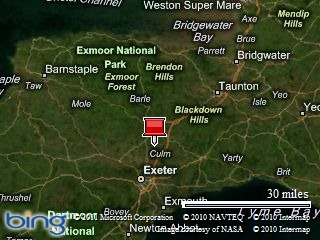
Map picture
Devon Somerset borders


         There has often been a writer who lives – or had lived – near me; someone, usually a woman, who lived and wrote in a nearby place or space in some way associated with mine. Sometimes I’ve known about the writer at the time I also lived there. Other times I’ve found out later – much later perhaps. Or alternatively, it is much later before I realise the importance of the fact of that writer being next door. Sometimes in the latter case, this information has come as a revelation and altered my perception of that time. Forever …

...    In the sixth form, our English teacher, Miss O’L., tells us about the writer living in the next door village. She’s called Jean Rhys and is notorious for her eccentricity and reclusiveness, so that it is unlikely she will come and talk to us; this fact means little to me or my friends. The woman is not famous, just a local eccentric and it is only many years later that I realise how significant was the book she was working on, titled Wide Sargasso Sea and yet, how incongruent the matching between that text and the mid-Devon locality where Rhys was then living.

…   I remember the small town gossip when Ted Hughes and his wife Sylvia Plath moved into our town next door to my aunt (godmother) and uncle– the doubled coldness of the winter snows and the stupefying shock and reverberations that circled our place as the news of the poet’s suicide reached the town in 1963. It was the year of the big-freeze, when my family moved away from the town. The poet’s death will always be bonded in my mind with the threshold-time that tore me away from childhood and into my teenage  years. Plath, poet next door, down the road, will for ever be inscribed with those weeks of change.

…   There was Tryphena Sparks, who another aunt had known; she told me about Sparks’ alleged affair with Thomas Hardy. A few years later Elizabeth Stuckley, from the famous Devon family, a novelist and children’s writer, buys as her holiday home a derelict cottage next to our farm. One morning she pops in to our farm and hands me a long reading-list of books, the most significant of which at the time was the Mazo de la Roche series; soon I find myself daring to take that wide leap from childhood reading towards adult literature. Now, 2011, I find through googling that Stuckley has already disappeared off the literary radar; none of her books feature on the web. I still treasure her 1960’s list of teenage recommended reading.

      …  Other Aunts told me about E.M. Delafield who had lived near Cullompton and written a witty Journal called The Provincial Lady and earlier in the C20, in my grandparents’ generation, the then famous early C20 romance writer Margaret Pedler had lived in the next door village. There was Eve Lewis, the Jungian psychoanalyst/writer who my parents knew; there was Jessie McGahey, my classics teacher godmother, who could and should have written, but didn’t. But that’s another story …

            In this global age when virtual Australia is next door on the screen, when we can at the drop of a hat link with any writer, anywhere, it is still vital not to forget, or belittle the local, the near at hand, on the ground at our feet and at what could or may have already, been lost, forgotten, or trivialised. The facts of our literal now, or in the past near-neighbours, may provide significance for our own personal future identity as writer and for the future historical recognition of neglected women writers of the region.

shared mind-space
        What books and who do you think of? There’s the mind-space, associative connotations coming from the realisation that you share a geographical locality or common-roots with another writer; even though one’s own texts may be of a different quality, the writings of the other-writer can resonate with that of one’s own inner-landscape and provide an imagined shared temenous. For example, Eavan Boland’s poem ‘Rooms of Other Women Poets’, creates an imagined bond between the women poets of the past and herself as poet/speaker in the imagined inner-landscape of creative poet-room. There could be inter or intra-texts, which encompass the shared networks of the same or related texts and words; there could alternatively be shared places, which have descriptions and interpretations of locations linked by similarity or difference.

         Devon’s two distinctive landscapes of moor and sea are especially relevant. For me, Plath’s poems resonate with echoes of the town in which I grew up; there’s shared memory and the comfort of recognition, even if interpretations of the locality differ. It was a shock to read in ‘The Beach’ in Hughes’ Birthday Letters, that Plath’s response to the sea-scapes of north Devon were anything but agreeable. How could it be possible for anyone to not be inspired by Devon's coasts? From Mary Patricia Willcocks there is fiction, often set on or beneath the moor. At times her style is preciously old-fashioned, but it provides a nostalgic, secure representation of an ordered world, which resonates with a world in which generations of her (and my) ancestors lived and worked. Willcocks’ novels are what Bob Mann described as ‘full of the romance of the past’ see his thoughts on her,  ‘Devon’s forgotten feminist’ here in a pamphlet about Ivybridge) which one’s own archetypal antennae tune into. From Frances Bellerby, in a poem ‘based on a particular road and valley on the western edge of Dartmoor’, reflections on light and eternity as they merge with the natural world, are intensified by the contrasting images of moorland scenery, with which anyone who knows and loves the moor can identify. From Elizabeth Barrett Browning, the eternal meditation on and of the sea in her poem ‘A Walk by the Sea’  tunes in with one’s own emotional response to south-western coastal mysteries.

surprise and serendipity! finding the local muse
        Elizabeth Podneiks, on a Dartmoor quest, in her search for a cluster of writers who stayed there in the 1930’s, expresses the aura of worshipful admiration, which kindles interior imagination. There’s a sense of, did she live and write here? It’s the kind of response I have to the knowledge that a writer, such as Jane Austen, George Eliot or H.D.  spent time within the boundaries of my own home county – in my territorial space and that whilst in the county that writer completed or was inspired to write a text that has now become what might be understood as a seminal text of her career. For instance, it was the landscape and scenery of Devon that George Eliot found to be the inspirational transforming agent that motivated her to become a fiction writer. In 1856, whilst staying in Ilfracombe with George Lewes the story is that she awoke one night from a dream with an idea for a work of fiction which eventually became Scenes of Clerical Life. Eliot seems to have been overwhelmed by the richness of the scenery surrounding her – the abundant flora and fauna, the sea-scapes, the rock-pools. Her Recollections of Ilfracombe tells the story of the beginnings of her transition to canonic fiction writer. Realising that the time spent in the county was one of a major turning-point in a writer’s life and writing is poignant and telling for the later writer; such was the case I believe with H.D.


         Such awareness provides in turn inspiration and motivation for later writers to go on adventures, on pilgrimages, quests, in search of a particular spot, ‘that place where that happened’; or alternatively travel in search of a now half-forgotten writer – one’s own personal writer-heroine-muse who has lived and written somewhere; perhaps in a cottage nearby whose photo appears in an article or biography. Where is that? What did she write there? What happened to her there?

writers in community
        When she stayed at Martinhoe HD was living and working with her then husband Richard Aldington; other friends and writers came and stayed with them and yet others lived nearby. This strand of writer-next-door takes into account writers who have lived within a community – both in terms of those who are or were engaged in the activity of writing and of those living nearby who might be affected by the nearness of the group. It suggest the inter-connections, the textual imprints left on the local topography and community and of this networked evolving meta-text that’s irretrievably written-on-that-local-landscape (I think especially of the effects of the presence of the long-standing Arvon community on the surrounding district).

       But writer-groups and networks are not just C20 phenomena. Travelling further back into Devon’s herstory, in the C17 Mary Lady Chudleigh, living in Ashton, seems to have been participatory in a network of women writing within the then manuscript culture.There is considerable interest in the search for the identities of those now lost women who may have been participants of her coterie And a century before that, during the Tudor period, there were groups of educated women engaged in literary activities who were linked to one another via several associative networks, including their religious and familial circles. Micheline White in a recent article (‘Women Writers and Literary Religious Circles in the Elizabethan West-Country’) has written of the ‘reconstruction of literary circles, coteries, networks and communities in the west-country’. She challenges the prevailing idea that women during the Elizabethan period – especially those living in the rural margins of the South-West counties – would have been writing in relative isolation.  Instead, White’s work proposes that
to excavate a region’s literary religious and kinship networks can yield surprising results about women writers’ engagement with local culture, their relationships to other women writers and their representation by their male peers. (See Women Writers).
White’s research has provided an impetus for finding about some of those Devonian Elizabethan women writers; each name that’s revived can act as a missing link in a hidden chain of other writers, whose lives and texts are now lost, but can still be surmised by these discoveries.

        More recently, in the 1930s, a group of literary friends spent most of two summers at a remote mansion in the middle of Dartmoor. One of them, Djuna Barnes, wrote the seminal text Nightwood, whilst staying at Hayford Hall. The other core women in the group, including Antonia White and Emily Coleman, achieved an experimental interplay of life, aesthetics and writing, which is now acknowledged to be representative of what has been called a ‘new female kind of lived Modernism’, providing a new slant to the analysis of the Modernist Movement.

         The search for a particular writer’s place or site of living can also help in filling in the gaps in the local literary map. Caroline Zilboorg, looking for H.D. in London, talks of the writer’s home in Mecklenburgh Square, of an impromptu visit she made there and how that gave her a real sense of the reality of HD’s time there.
The biographical work that still needs to be done is sometimes the scholarly spadework of chronology and editing, and even the study of photographs and geographical meanderings (see essay in Sagetrieb)
Zilboorg stresses how it is important to search out a particular site associated with a writer; not only does it feed the imagination but also such a quest provides the nitty-gritty of specific information essential to filling in the gaps in knowledge, so as to fill out archival reference points on the incomplete map of texts and writers associated with that location. Devon’s landscape is peppered with evidence - churches (many of which are rapidly deteriorating); inscribed memorials; manuscripts (including wills, letters, journals, poetry) and archaeological sites. Most of these are as yet to be re-discovered. I had a difficult task trying to find where the grave of the writer Charlotte Chanter is located in Ilfracombe; although I knew it was there, the churchyard was huge and overgrown; it took several letters and visits to the local museum before the exact mapping of the grave could be identified: it had fallen over long ago and the inscription could only just be deciphered and can’t be read in the photo I took.
100_0710
Charlotte Chanter's grave at Ilfracombe

chudleigh1
Screen at Ashton Church
        Looking for information about Mary Lady Chudleigh at Ashton, knowing already that there is no memorial of her burial there, it was a lovely surprise to find that within the church  there is still much remaining in the way of contemporary memorials; those memorialising the death of her children and in-laws as well as a wonderful screen that may have been placed there during, or just before, Chudleigh’s own life-time.
       One afternoon I found myself in Dunsford Church, staring at the large monument which represents the joint recumbent effigies of both Ursula Fulford and her husband Thomas, as well as their seven children; I was on the trail of the C16 Ursula, a contemporary of Anne Dowriche, who may have been one of that poet’s coterie. A sixteen-line verse inscription on the monument included Fulford’s own assessment of his wife, praising ‘his Mate in all his life, for being a true and virtuous wife’. Micheline White believes that the inscription may have been composed by Ursula herself (see Women Writers).
Fulford Monument at Dunsford Church


        So, with this sort of work, the literary history of the neighbourhood can be re-established and retrieved and it becomes possible to begin to re-assess particular aspects of that history. The balance between male and female writers can be re-formulated to challenge the prevailing notion of the predominance of Devon’s men-writers …

…   There are so many possibilities. Imponderables.

       For instance, just one speculation: supposing we jump up swiftly through the centuries from the heartlands of pre-Roman Devon, up to C16 England, and consider a woman who landed in Plymouth in 1616, then passed through Devon on her way to London – the legendary Indian Princess Pocahontas. Did she exist? Probably. But the story that has accompanied her up through the years can not easily be verified and there are several conflicting interpretations.

      If only there was a diary, written by the girl herself.

      Who knows, perhaps Pocahontas kept such a journal, recounting the real story of her adventure, before she died at the start of her return journey. Legend has it that she was barely fluent in English and didn’t tell her own story, but surely it is possible that she kept a diary, at least in minimal form. However, instead of hearing her own voice, we learn much later in the C19 from a bevy of other writers about the legendary fate of the Indian girl; it is an illusive, shifting and ever-evolving legend, some of which can be proven, some of which will remain guesswork: an allegory for this quest for lost women writers from Devonshire. If there is the possibility that Pocahontas did indeed write her own story, we’ll never get the chance to read it, except through speculative fictional accounts. Why not then conjure up such a narrative, to enable others to understand who she was and what her story may have been. Then, after that ,why not consider other might-have-beens, stories about women known and named whose texts we either have, or who wrote texts that are not anymore extant; women known to have lived and who could easily have written; and those who may have lived and written.

     Somehow, in a reconstructed textual world, all the threads of all the stories would inter-connect, but if that metatext can never be achieved, gaps in the stories of each, or all of these scenarios, can at least be suggested.

Who knows, perhaps there is some enchanting material about our county flying round in the nearby territories of cyberspace ...
... Perdita has lost her way into the future in the green westcountry woods she sinks into oak leaves this is the ice age drift leaves are frozen white crisp edges sting her skin she has no blanket there are no paths in this wood to direct her way there are a few birds doves high up in fir trees icicles glisten from branches beaks are frozen Perdita kneels and peers over the precipice of the stone quarry she has narrowly missed a bad fall into the past misadventure follows her a wasp buzzing behind her thin shoulders She sees what she thought was lost for ever Perdita’s Father is memory she sees rubbles of stones in loose piles stacked from the past to the future …
and now I’ve moved to a county which neighbours Devon - Somerset. Shall I find another writing woman living next door?

(The above consists of excerpts from a longer unpublished piece)