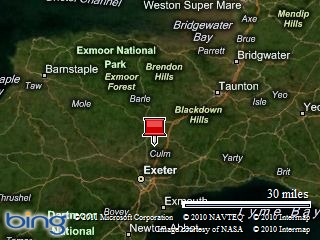
 Margaret (Bass) Pedler was on her way to becoming a well known writer of romantic fiction by 1919 when her second novel The House of Dreams come True was published - ninety years ago this year. I can't help wondering if the book's title encodes the accoutrements of the recently completed Carter-Pedler family folly/home near Zeal-Monachorum, called Reeve Castle. (No photo of the folly yet here but I hope to get one). Certainly the story begins with an atmospheric evocation of a dark old and spooky entrance hall - but that is a mansion in France not Devon. So maybe there is no link here between fiction and life. But, later in the story Jean, the beautiful young heroine, arrives in Devon and travels to a destination not too far from Exeter, which anyone familiar with that part of the county, between Okehampton and Crediton, would even now recognise as the mid-Devon countryside. There's the ubiquitous red soil "glowing jewel-like through filmy wisps of morning mist", which Jean notes on her first encounters with the countryside in the moonlight whilst in early morning mist: "gracious curves of distant hills" and mist "filled the valleys to a nebulous pearly glimmer" and the "foot of the hills seemed laved by some phantom sea of faery"; it's a scene of shadowed,half-revealed landscape" where "back of it all, adumbrated in a dim mysterious purple, the great tors of Dartmoor rose sentinel upon the horizon." For those born beneath its shadow the looming mound of Cawsand/Cosdon hill rising up behind Okehampton must surely always be remembered and re-envisioned as a matriarchal archetypal mound of protection and security - akin perhaps to a Devonian Silbury.
Names of places in the novel are different yes, but its settings are obviously taken and adapted from the author's personal familiarity with the nooks and crannies of that landscape. P edler may have been influenced by the requirements
 edler may have been influenced by the requirements
of the then up and coming romance-novel which inferred that authors render saccharine ornate, romanticised landscape backgrounds for their sob-story plots. But maybe she was also affected by and attuned to the spirit of the place - "nemetotatio" or Devon's sacred grove.
But that's digressing, here ...
Other than reading Mazo de la Roche and the Jalna series in teenage years I've never had the time to read much in the romance fictional mode - career threads have taken me along more heavily canonic literary reading-routes. Good to have an excuse to put these aside and escape, then follow younger female persona-selves as they wander along, beside and inside the tracks of high hedges of one's own beloved landscapes - with the women who inhabit these novels.
I find I am perhaps even eerily shadowed by those women even closer to me - Grandmothers, Aunts and Great Aunts, (also then and before, living within the vicinity) some of whose (romantic, even torrid) stories were related to me over the years and whose lost voices somehow echo in my head as I read Pedler's transmutations of the romance genre.Of course, the romantic novelist's usual elements permeate the story - the atmospheric (often mist-drenched landscape) scenes and setting of a mysterious mansion or castle, whose effect is enhanced with a giant cedar-tree, walled rose-garden, sunken lawn and ancient sundial. (Not far from Reeve there are other similar places, such as Ashridge Court not more than what three miles away from Reeve, as the crow flies). But Pedler may well have been drawing from immediate experience, rather than (or as well as) making use of the conventional ploys of her genre.
I'm not sure yet when the novelist married, as the second wife of William George Quick Pedler, into that local family, but the date can't have been too many years before the publication of her first novel, The Splendid Folly (which I have not yet seen but whose title also suggests links with Reeve) in 1918. She must have been all too aware of the eccentricity of the building in or around 1900, of the castle folly Reeve, by William Carter Pedler, who must have been a cousin of the Quick-Pedlers. He had apparently designed the castle as a gift for his young wife. (My father took me there once in the mid-fifties when it had been left to decay: it was a creepy place and for us children a Gothic place of fantastic imaginings every time we travelled the road between North Tawton and Bow; I recall a massive entrance hall with cobwebs settled over bannisters and holes-to-the-sky in the ceilings. Reeve was a Miss Havisham kind of place: the story was that an aunt in my family had once gone to work as a companion to the Carter-Pedlers during the second work war, but "something" had happened to scare her and she stayed only a day or two before ringing the family to be rescued).
I don't know how long the Carter-Pedlers lived there but during the first world war Reeve seems to have been used to house injured Officers - perhaps by the time that Margaret Pedler was in Devon writing her fiction it was inhabited again by the family and during these years she would have visited the Pedler relations, for her home was only up the road, at Baron's Court, near Zeal Monachorum.
Other than reading Mazo de la Roche and the Jalna series in teenage years I've never had the time to read much in the
 romance fictional mode - career threads have taken me along more heavily canonic literary reading-routes. Good to have an excuse to put these aside and escape, then follow younger female persona-selves as they wander along, beside and inside the tracks of high hedges of one's own beloved landscapes - with the women who inhabit these novels.
I find I am perhaps even eerily shadowed by those women even closer to me - Grandmothers, Aunts and Great Aunts, (also then and before, living within the vicinity) some of whose (romantic, even torrid) stories were related to me over the years and whose lost voices somehow echo in my head as I read Pedler's transmutations of the romance genre.Of course, the romantic novelist's usual elements permeate the story - the atmospheric (often mist-drenched landscape) scenes and setting of a mysterious mansion or castle, whose effect is enhanced with a giant cedar-tree, walled rose-garden, sunken lawn and ancient sundial. (Not far from Reeve there are other similar places, such as Ashridge Court not more than what three miles away from Reeve, as the crow flies). But Pedler may well have been drawing from immediate experience, rather than (or as well as) making use of the conventional ploys of her genre.
I'm not sure yet when the novelist married, as the second wife of William George Quick Pedler, into that local family, but the date can't have been too many years before the publication of her first novel, The Splendid Folly (which I have not yet seen but whose title also suggests links with Reeve) in 1918. She must have been all too aware of the eccentricity of the building in or around 1900, of the castle folly Reeve, by William Carter Pedler, who must have been a cousin of the Quick-Pedlers. He had apparently designed the castle as a gift for his young wife. (My father took me there once in the mid-fifties when it had been left to decay: it was a creepy place and for us children a Gothic place of fantastic imaginings every time we travelled the road between North Tawton and Bow; I recall a massive entrance hall with cobwebs settled over bannisters and holes-to-the-sky in the ceilings. Reeve was a Miss Havisham kind of place: the story was that an aunt in my family had once gone to work as a companion to the Carter-Pedlers during the second work war, but "something" had happened to scare her and she stayed only a day or two before ringing the family to be rescued).
I don't know how long the Carter-Pedlers lived there but during the first world war Reeve seems to have been used to house injured Officers - perhaps by the time that Margaret Pedler was in Devon writing her fiction it was inhabited again by the family and during these years she would have visited the Pedler relations, for her home was only up the road, at Baron's Court, near Zeal Monachorum.
Actually, about Margaret Pedler herself there seems to be sparse information, but it is known that she was a gifted musician and before her writing career had been to the Academy of Music to train as a singer - apparently writing and publishing some songs as well. So far I have not been able to track down any of these, but have recently found that she wrote a song (published the same year as the book) with the same title as the novel, House of Dreams; it seems to have been co-composed and co-authored by Harold Pincott, who apparently was her literary executor. One reviewer noted that she was a "collector of old furniture and china and a devotee of driving, tennis and swimming".
It is known that Margaret Pedler was from a Devonian family, called Bass; her father Thomas was from Teignmouth. That is all I know, as yet, of her background.You can find copies of House of Dreams (as well as many of Pedler's other novels) easily on web - book-sites - they are still very popular in the States, but out of print in England - and you may find her labelled as an American writer. When she was writing these books her reputation and status was compared to the then other well-known and sought-after women writers of romance, including Ethel M Dell and Ruby M Ayres; now I notice she has more or less been erased from these lists of early C20 popular cultural literature.There's a contemporary review of the novel (1920) from the New York Times which approves of the book and its heroine who "romanticises about the castle of her youth, calling it the House of Dream come True ... where in the last chapter she finds love at last".
Interestingly the manuscript of House of Dreams is in the Westcountry Studies library (the only one of her books there as far as I know). Also you can search Pedler family records in the DRO but as far as I can see so far these are mostly re business and finance. My intention is to return to Margaret Pedler and her romance books and their links with mid-Devon; any excuse to return to my own roots and source-places of writerly fantasy.
It is known that Margaret Pedler was from a Devonian family, called Bass; her father Thomas was from Teignmouth. That is all I know, as yet, of her background.You can find copies of House of Dreams (as well as many of Pedler's other novels) easily on web - book-sites - they are still very popular in the States, but out of print in England - and you may find her labelled as an American writer. When she was writing these books her reputation and status was compared to the then other well-known and sought-after women writers of romance, including Ethel M Dell and Ruby M Ayres; now I notice she has more or less been erased from these lists of early C20 popular cultural literature.There's a contemporary review of the novel (1920) from the New York Times which approves of the book and its heroine who "romanticises about the castle of her youth, calling it the House of Dream come True ... where in the last chapter she finds love at last".
Interestingly the manuscript of House of Dreams is in the Westcountry Studies library (the only one of her books there as far as I know). Also you can search Pedler family records in the DRO but as far as I can see so far these are mostly re business and finance. My intention is to return to Margaret Pedler and her romance books and their links with mid-Devon; any excuse to return to my own roots and source-places of writerly fantasy.